Sometimes, the most interesting thing AI produces is something we never asked for.
An illustration contains an unexpected detail. A story takes an unplanned direction. A suggestion that initially seems unrelated to our conversation opens an entirely new avenue of thought.
The result may not resemble what we originally imagined, yet something about it captures our attention.
Instead of asking AI to correct it, we find ourselves wondering what might happen if we explored it further.
Creative history is filled with unexpected discoveries, experiments that produced surprising results and ideas that emerged from circumstances nobody deliberately arranged.
Working with AI introduces another environment in which these moments can occur.
And sometimes, the difference between a mistake and a discovery lies in what we notice.
When the Unexpected Becomes Interesting
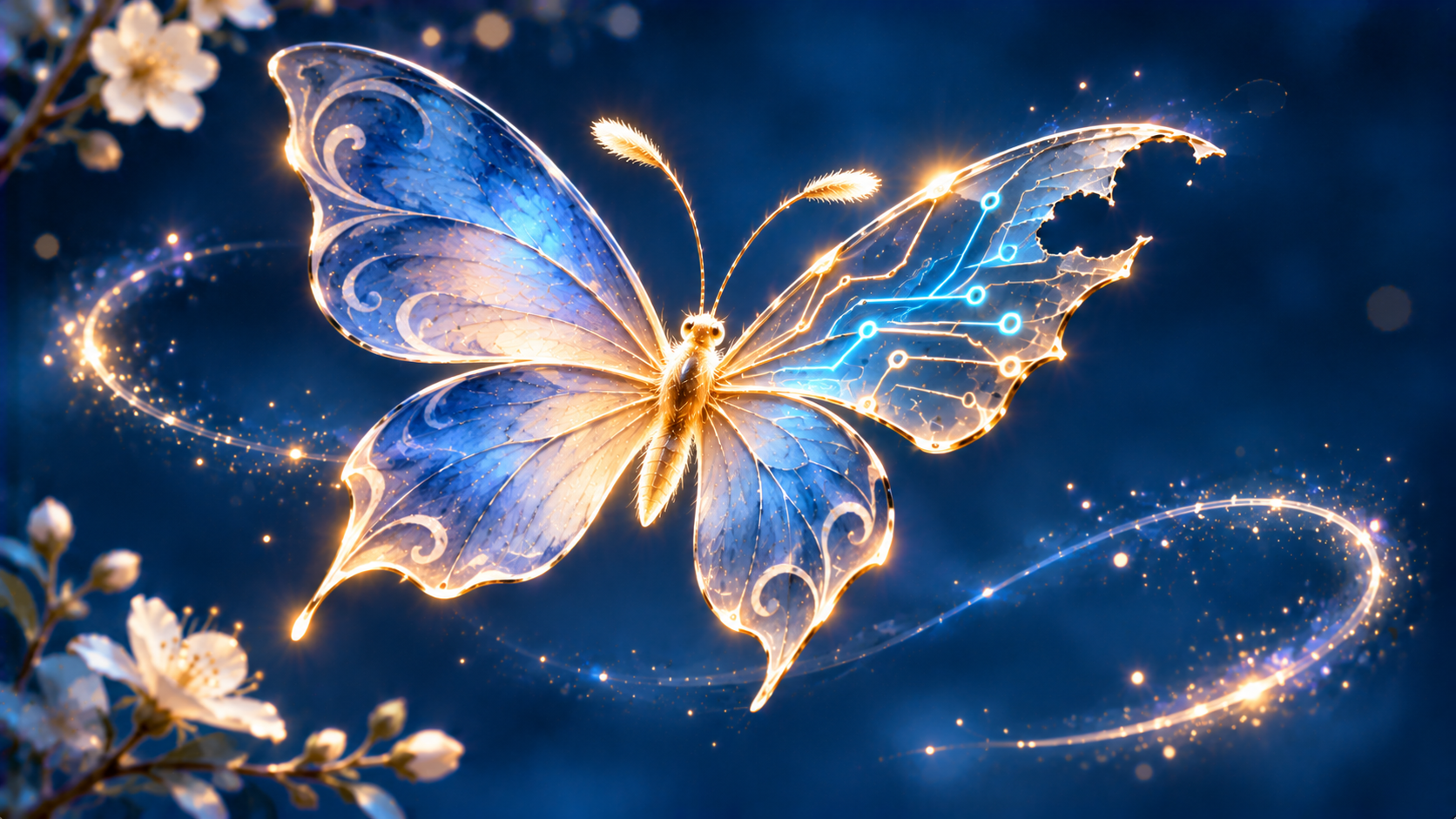
Imagine asking AI to create an illustration of a butterfly surrounded by delicate, shimmering trails.
The result contains something rather different. Instead of graceful trails, the butterfly appears surrounded by tiny electrical sparks.
It isn't what you requested.
But there is something rather appealing about it.
Perhaps the sparks suggest a mischievous personality. Perhaps they inspire the idea of a character who approaches technology with enthusiasm but doesn't always manage to make things work.
What began as an inaccurate interpretation has introduced a possibility that wasn't part of the original idea.
We could ask AI to remove the sparks and return to our initial vision.
Or we could explore what those sparks might become.
Neither choice is inherently better. Both reflect different creative intentions.
The interesting part is that we now have a choice we didn't have before.
The Accident Is Only the Beginning
It can be tempting to attribute an unexpected creative discovery entirely to the accident that produced it.
However, an accidental result does not automatically become something meaningful.
Someone has to notice its potential.
Consider a photographer reviewing a collection of images. One photograph is slightly blurred, capturing movement in a way that wasn't intended.
Another person might immediately discard it. The photographer, however, might recognise something expressive in the blur and decide to explore that effect deliberately.
The original accident created an opportunity, but recognising and developing that opportunity involved creative judgement.
Something similar can happen when working with AI.
An unexpected image, phrase or suggestion may contain hundreds of details. We notice certain elements because they connect with our interests, experiences, preferences or imagination.
Another person looking at exactly the same result might notice something entirely different.
The creative significance of an unexpected result is not necessarily contained within the result itself.
It can emerge through our response to it.
When an Idea Takes Us Somewhere Else
Not all unexpected discoveries involve AI getting something wrong.
Sometimes, a perfectly reasonable response introduces an idea that we simply hadn't considered.
Perhaps we are discussing a fictional character and AI suggests a particular setting. The setting reminds us of something from our own experience, which leads to a different character, a new storyline or an entirely separate creative project.
The original suggestion may not even survive in the final creation.
Its value was in opening another direction.
This is one of the interesting qualities of exploratory conversation. Ideas can connect, diverge and develop in ways that are difficult to anticipate at the beginning.
We might start by exploring a question about artificial intelligence and find ourselves discussing creativity, education, philosophy or human behaviour.
What began as a relatively small curiosity can develop into something considerably larger.
Not because every suggestion is particularly profound, but because the connections we make between ideas can lead us somewhere unexpected.
Sometimes, the most valuable outcome of a conversation is a question we didn't know we wanted to ask.
The Difference Between an Error and a Happy Accident
Of course, not every unexpected result deserves to be celebrated.
An inaccurate explanation of a medical condition is not a creative opportunity. An invented reference in a research article is still an invented reference. An error in a financial calculation remains an error, regardless of how interesting the result might appear.
Even within creative work, some mistakes are simply mistakes.
If we are designing a poster for an event, an incorrect date needs correcting. If we are creating an illustration of a particular animal, an anatomical error may undermine what we are trying to achieve.
The context matters.
There is a considerable difference between exploring possibilities within an open-ended creative project and relying on AI to provide accurate information or fulfil a specific requirement.
Recognising the potential of unexpected results does not mean abandoning accuracy, purpose or critical judgement.
It means allowing room for interpretation where interpretation is appropriate.
Sometimes, the unexpected offers an opportunity.
Sometimes, it really does just need fixing.
Leaving a Little Room for Surprise
When we have a very specific idea in mind, it is natural to evaluate each result according to how closely it resembles that idea.
There are many situations where this is exactly what we need.
But during more exploratory creative work, there can also be value in occasionally considering a result on its own terms.
An illustration may not suit the project we are currently developing, yet it might be beautiful in a completely different context.
A phrase may not belong in the article we are writing, but it could become the starting point for another article.
A design may fail to capture the personality of one character while unexpectedly suggesting the personality of another.
We don't necessarily need to change our original project to accommodate every interesting discovery.
Sometimes, we can simply keep the idea for another occasion.
Over time, these little discoveries can become a collection of possibilities: fragments of stories, visual concepts, interesting questions or ideas waiting for the right moment.
Something that doesn't belong today may find a place tomorrow.

When the Unexpected Changes Our Understanding
Unexpected discoveries can also influence how we think about creativity itself.
Imagine exploring a single concept through several different illustrations.
Each image represents the same broad idea, yet one uses familiar imagery, another approaches it through abstract symbolism, and another presents something that initially seems quite unrelated.
As we examine the differences, we may begin questioning our own assumptions about how that concept should be represented.
Why did we expect a particular image?
What makes one interpretation feel more meaningful than another?
Why does something unfamiliar sometimes capture our attention more effectively than something we immediately recognise?
The unexpected result becomes more than an alternative creation. It becomes an opportunity to explore our own thinking.
We may discover that our understanding of a concept was narrower than we realised, or that there are aspects of an idea we had never considered expressing visually.
The discovery is not necessarily about what AI has created.
It may be about what the experience has encouraged us to reconsider.
Curiosity Without Losing Direction
There is, naturally, another side to all this exploration.
Following every interesting possibility can make it remarkably difficult to finish anything.
One idea leads to another, which leads to another, and before long, the original project is surrounded by half-developed concepts that all seem equally fascinating.
Creative exploration and creative direction can sometimes pull us in different ways.
There may be occasions when we want to follow an unexpected idea immediately. At other times, we might prefer to record it and continue with what we were originally doing.
And sometimes, an interesting possibility is simply enjoyable to consider without needing to become a project at all.
Not every discovery needs to be developed into something tangible.
There is room for curiosity that exists purely for the pleasure of exploring.
The Possibilities We Couldn't Have Planned
One of the joys of creative collaboration is that we cannot always predict where it will take us.
If every result precisely matched our initial expectations, we might achieve what we intended with remarkable efficiency.
But we might also miss some of the possibilities that emerge when things unfold differently.
This does not make unpredictability inherently desirable, nor does it mean that we should welcome every mistake.
Rather, it suggests that there can be value in occasionally looking beyond whether something is right or wrong and considering whether it is interesting.
Some of our discoveries will be small. Others may influence the direction of an entire creative project.
And some may simply make us laugh.
There is something rather wonderful about encountering an idea we could not have deliberately requested because, until that moment, we hadn't imagined it.
Sometimes, the most interesting discoveries begin with something that wasn't supposed to happen.